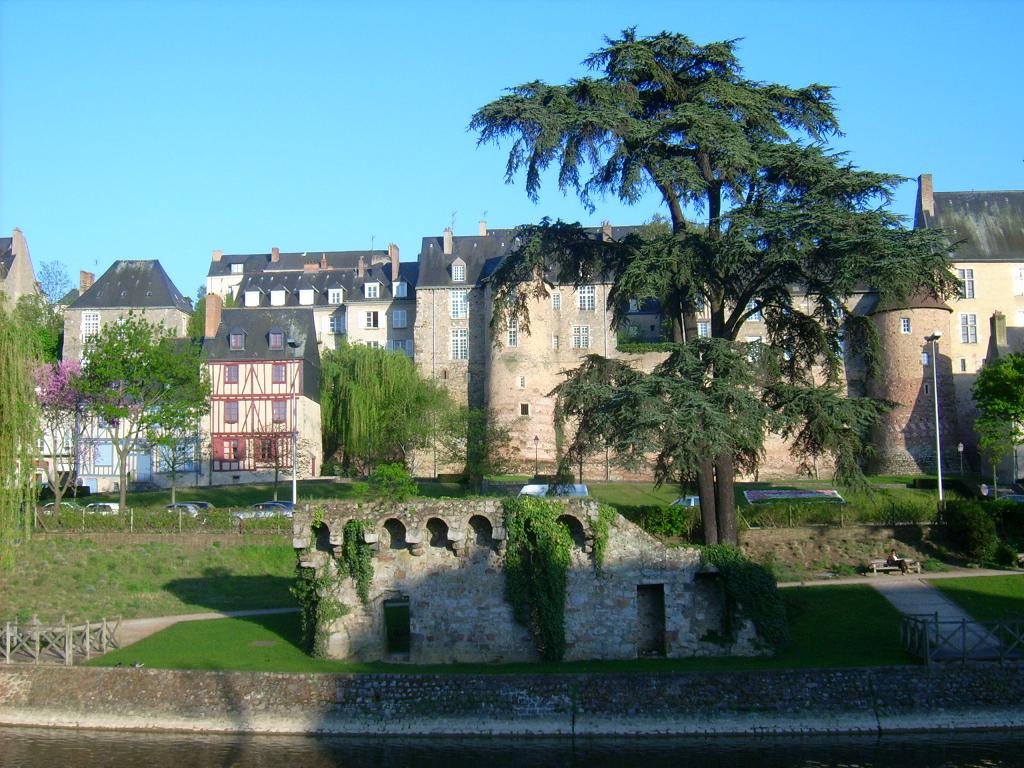
In the heart of Le Mans lies one of the best preserved medieval treasures in France. The Cité Plantagenêt — known from Les Manceaux as Old Mans — offers 20 hectares of paved streets, half-timbered houses and intact Roman ramparts that seem frozen in time. And yet, this district is indeed alive and well: its inhabitants live there, its terraces come alive in the evening, its streets are still used as a set for costume movies. A place that is both a museum and a village, which motor racing fans who stop in Le Mans often discover with amazement.
1,700 years of history in 20 hectares
The history of the Plantagenet City dates back well before the Middle Ages. Vindunum, capital of the Gallic people of the Aulerces Cenomans, became a flourishing Roman city as early as the 1st century. In the 4th century, in the face of barbarian invasions, the city retreated and surrounded itself with a colossal fortified enclosure, built between 320 and 360 AD. It is these ramparts that have survived the centuries and today make the neighborhood famous.
The major dynastic turn came in the 12th century. On June 17, 1128, the marriage of Geoffroy V of Anjou — nicknamed “le Bel”, who carried a branch of broom in his coat of arms and gave his name to the Plantagenets — was celebrated at Saint-Julien Cathedral. Five years later, on March 5, 1133, a certain Henry, future Henry II of England, founder of the Plantagenet Empire, was born at the Palace of the Counts of Maine, at the Palace of the Counts of Maine, a certain Henry, who was to become the founder of the Plantagenet Empire, which would soon extend from the Pyrenees to Scotland.
Le Mans thus became one of the capitals of an empire larger than France at the time. Richard the Lionheart stayed there. Eleanor of Aquitaine, one of the most powerful women of the Middle Ages, exerted her influence there. This exceptional royal past is the reason why the district was officially renamed Cité Plantagenêt in 2003.
In 1066, the inhabitants of Le Mans created what is recognized as the first commune in France, emancipating themselves from royal authority. A tradition of independence that continues: in 1979, Vieux Mans was proclaimed a “free commune” — a distinction shared only with Montmartre in Paris.
The Roman ramparts: one of the most beautiful in France
They are the ones you see first when arriving from Sarthe. The Gallo-Roman enclosure of Le Mans is considered to be one of the best preserved in Europe. Classified as a Historic Monument since 1862, a candidate for UNESCO World Heritage since 2016, it deserves attention.
The numbers make you dizzy: 500 meters of intact curtain walls, walls 4 to 5 meters thick at the base, a height of 10 meters for the walls and up to 17 meters for the towers. Of the original 26 to 40 towers, 11 to 12 are still standing today.
But what makes these ramparts unique is their polychromy. Roman builders alternated lines of red brick, Roussard sandstone (local ochre-pink stone), white limestone and pink mortar to create geometric friezes in diamonds, chevrons and arches. No other Roman enclosure in France has this decorative sophistication. It is this palette that earned Old Mans its nickname “red city”.
The wall survived because it also acted as a retaining wall for medieval buildings built against it. The gradual rise of the interior floor protected it. A happy coincidence that allows us to admire this masterpiece of Late Antiquity today.
Tip: go down to the foot of the ramparts on the Sarthe side (Escalier des Pans-de-Gorron) to see them from the outside. The perspective on the towers and the polychromy is striking, especially in the late afternoon when the golden light makes the red bricks vibrate.
Saint Julian's Cathedral
It's hard to miss the cathedral: it has dominated the district since the 4th century. The construction of the current building lasted from the 11th to the 15th centuries, creating a fascinating dialogue between Romanesque nave and flamboyant Gothic choir. At 134 meters in length and 5,000 m² in area, it is one of the largest cathedrals in France.
What really sets it apart are its stained glass windows. Several date from the 12th century and the set is considered to be comparable, in quality and antiquity, to the stained glass windows of Chartres Cathedral. A wealth unknown to the general public. Take the time to let your eyes get used to the darkness and let yourself be surprised by the intensity of the blues and reds.
Not to be missed inside: the Chapel of the Musical Angels with its painted vault, and the royal Romanesque porch with its sculptures. Outside, walk around the cathedral to admire the Gothic bedside from the Queen Bérengère Gardens — one of the most elegant architectural panoramas in the region.
Admission: free (free visit); grandstand 2 to 3€
Opening hours: open all year (hours vary according to season, consult cathedraledumans.fr)
Rue de la Reine Bérengère: the most photographed street in Le Mans
If Old Mans had only one address, it would be that one. Rue de la Reine Bérengère is lined with half-timbered houses from the 15th and 16th centuries, some of which lean slightly as if whispering secrets to each other. The House of Two Friends and the House of the Red Pillar are the most emblematic.
Queen Bérengère's House — named after the Spanish wife of Richard the Lionheart, who ended her days in Le Mans — formerly housed a museum that was closed in 2022. The ethnological collections have joined the Plantagenêt Square. But the facades themselves, classified as Historic Monuments, are worth the stop. Sit at the end of the street and take the time to look: the corbelled floors, the sculpted beams, the mullioned windows. It is an image of Le Mans that cannot be found anywhere else.
The 5 essentials of the Plantagenêt City
1. The Roman ramparts seen from Sarthe — Go down to the foot of the walls to see the 500 meters of polychromy from the bottom. The perspective is spectacular.
2. Saint Julian's Cathedral and its 12th century stained glass windows — Don't pass by without entering. Medieval stained glass windows are among the best preserved in France.
3. Rue de la Reine Bérengère — The most beautiful half-timbered street, a must for photography.
4. Le Carré Plantagenêt — The city's archeology and history museum, housed in an inventive contemporary architecture. Ideal for understanding the historical context before or after the walk. Price: €5, free on Sundays for residents of the agglomeration.
5. The Grande Rue and its multicolored half-timbered houses — The main axis of the city, animated by craft shops and restaurants with shaded terraces.
Old Mans at the movies
Movie decorators know it: it is difficult to find such authentic medieval scenery in France. Old Mans has hosted around twenty major shootings since the 1970s.
The best known:
Cyrano de Bergerac (1990) by Jean-Paul Rappeneau with Gérard Depardieu — several iconic scenes shot in the cobbled streets
The Man in the Iron Mask (1998) with Gérard Depardieu and Leonardo DiCaprio
The Hunchback (1997) with Daniel Auteuil and Fabrice Luchini
Molière (2006) with Romain Duris
Let the party begin (1975) by Bertrand Tavernier with Philippe Noiret and Jean Rochefort
Walking along Grande Rue or Rue de la Reine Bérengère, it is not uncommon to recognize a shot from a movie seen a long time ago. An unexpected cinephile dimension that adds a layer of fun to the ride.
La Nuit des Chimères: the summer magic of the neighborhood
Every summer, the Cité Plantagenêt is transformed at nightfall. La Nuit des Chimères is a journey of lights and monumental projections on the facades of the district — ramparts, cathedral, half-timbered houses. The show is completely free and available without reservation.
In 2026, the Night of the Chimères takes place from July 2 to September 20, every evening at nightfall. This year's edition pays tribute to sound professionals: portraits of sound engineers, artists and researchers are projected onto iconic monuments in a light and sound setting.
If you visit Le Mans between July and September, do not return to your accommodation until you have taken a tour of the city after 22:00 The atmosphere is incomparable to the day visit.
Practical information
How do I get to Old Mans?
By train: Le Mans is 55 minutes from Paris by TGV. From the station, Old Mans is 15-20 minutes away on foot (ascent from the center), or accessible by tram (line T1) to the Republic and then a few minutes on foot.
By car from Paris: A11 motorway, exit Le Mans Centre. Approximately 2 hours from Paris.
Where to park?
Jacobins parking (recommended): Place des Jacobins, a stone's throw from the entrance of the city. 388 spaces, very accessible price (€1 for 6 hours after 19:00).
Quinconces P1 and P2 car parks: 398 and 610 spaces, open early in the morning, with electric charging stations on the P2.
How much time should I expect?
Quick stroll: 2 hours to explore the main streets and see the cathedral from the outside.
Half-day: visit the interior of the cathedral + a museum + terrace.
Full day: including the Carré Plantagenêt, the descent to the foot of the ramparts and a boat trip on the Sarthe.
Mobile app
GuidiGO offers an official self-guided tour of the Plantagenêt City, available on iOS and Android. Ideal for visiting at your own pace with rich audio content.
Le Mans: motorsport and the Middle Ages, the duality that surprises
Each year in June, 250,000 to 300,000 spectators from around the world converge on Le Mans for the 24 Hours. Many have their eyes on the circuit. But those who take the time to push to the city center leave with a different image: medieval streets silent at dawn, illuminated Roman ramparts, a cathedral with 900-year-old stained glass windows.
It is this duality — the capital of motor racing and the cradle of the royal house of Plantagenêts — that makes Le Mans unique in France. The city understood this well with its slogan “Of Course, Le Mans”, playing on the double meaning: “of course, Le Mans” and “the race, Le Mans”.
Where to sleep to visit Old Mans?
To fully enjoy the historic district — and in particular the Night of the Chimères in the evening — it is best to sleep nearby. Downtown hotels fill up quickly during major events.
Chez Béranger is a charming apartment located in the very heart of Le Mans, a few steps from Old Mans and half-timbered houses. An ideal base for exploring the city at your own pace, without time constraints or returning by car. The terrace and the calm of the cobbled streets when you wake up — an experience that hotels on the outskirts cannot offer.
Frequently asked questions about Old Mans
Is Old Mans free to visit?
The stroll through the alleys is completely free and accessible at any time. Saint-Julien Cathedral is free (free access). The Carré Plantagenêt (museum) is chargeable: €5 for adults.
What is the best season to visit Old Mans?
The neighborhood is beautiful in all seasons. In summer, the Night of the Chimères (July-September) is a must. Spring and autumn offer magnificent lights on the facades. In winter, the neighborhood is covered in garlands and the atmosphere is intimate.
Why is Old Mans called Cité Plantagenêt?
In reference to the Plantagenets dynasty, born in Le Mans (Henry II of England was born there in 1133) and who reigned over an empire ranging from the Pyrenees to Scotland. The district was officially renamed Cité Plantagenêt in 2003.
Are the Roman ramparts of Le Mans the best preserved in France?
Yes, the Gallo-Roman enclosure of Le Mans is considered to be one of the best preserved in Europe, with 500 meters of curtain walls intact. Its decorative polychromy (red bricks, Roussard sandstone, limestone) is unique in France.
Were any movies shot in Old Mans?
Many films have been shot there thanks to the authenticity of the settings: Cyrano de Bergerac (1990) with Depardieu, The Man in the Iron Mask (1998) with DiCaprio, The Hunchback (1997) with Auteuil, Molière (2006) with Auteuil, Molière (2006) with Duris, and around twenty other productions.